
Originally published in Waikato Times, Monday 19 January 2026.
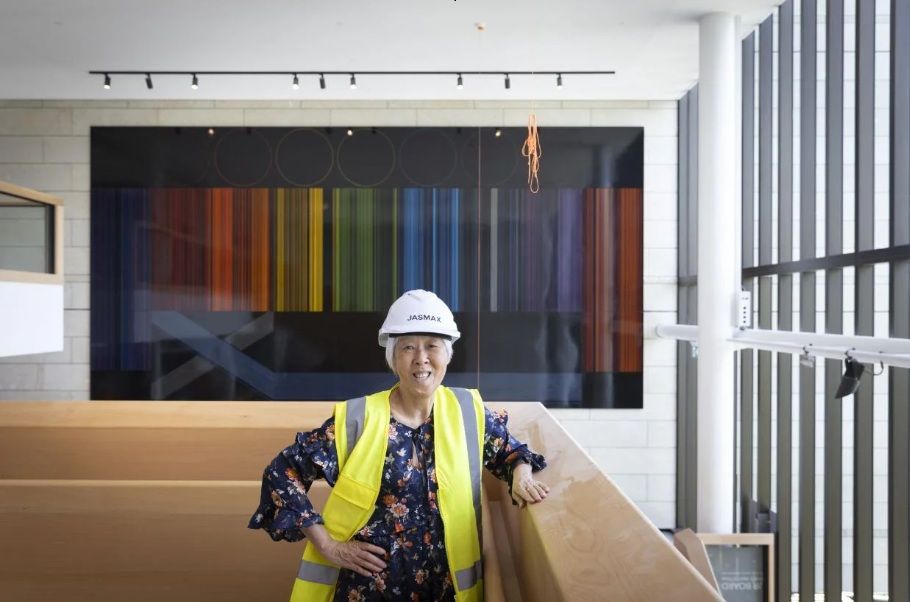
Art critic, collector and philanthropist Nancy Caiger has sponsored the part of the BNZ Theatre known as the Caiger Landing. PHOTO: Kelly Hodel / WAIKATO TIMES.
When the new $80 million BNZ Theatre opens its doors in January, it won’t just be unveiling a cutting-edge performance venue. It will also reveal a pair of cultural and historic treasures that tie the city’s future to its past.
Dominating the river-facing foyer is a large-scale painting created in 1973 by one of New Zealand’s most celebrated artists, Ralph Hotere. And just a few steps away, in the hospitality area of the new building, visitors will once again tread the oak staircase meticulously salvaged from the former Hamilton Hotel.
Together, the Hotere and the 102-year-old American oak staircase are centrepieces of a venue that has been designed not just to entertain, but to reflect Hamilton’s cultural identity and heritage.
The Hotere work is already familiar to many Hamiltonians. Commissioned jointly by the Hamilton City Council and the Queen Elizabeth II Arts Council, the work was selected from five finalist designs for the Founders Theatre in 1973. The other finalists included well-known artists Colin McCahon, Paratene Matchitt, and Ray Thorburn.
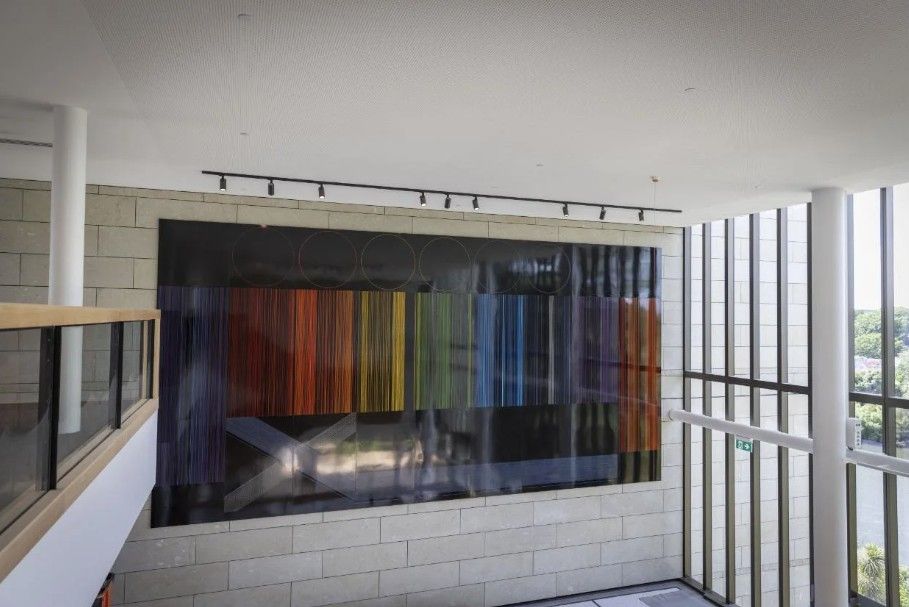
Ralph Hotere's work has found a new home. PHOTO: Kelly Hodel / WAIKATO TIMES.
Unveiled in August 1973, the painting remained a fixture of the Founders Theatre foyer until the building was closed in 2016 due to seismic concerns and the failing flying system above the main stage. When the theatre was shut down, the piece was carefully removed and placed into storage—its future uncertain, but its importance never forgotten.
That future has now arrived.
The artwork has been installed in the main foyer of the theatre, immediately above a space named Caiger Landing, after Hamilton art critic and philanthropist Nancy Caiger, who sponsored the work. Caiger said she was thrilled to see it finally back in public view.
“It’s been far too long for this piece to have been out of the public eye. Now here it is, in its forever home,” she said.
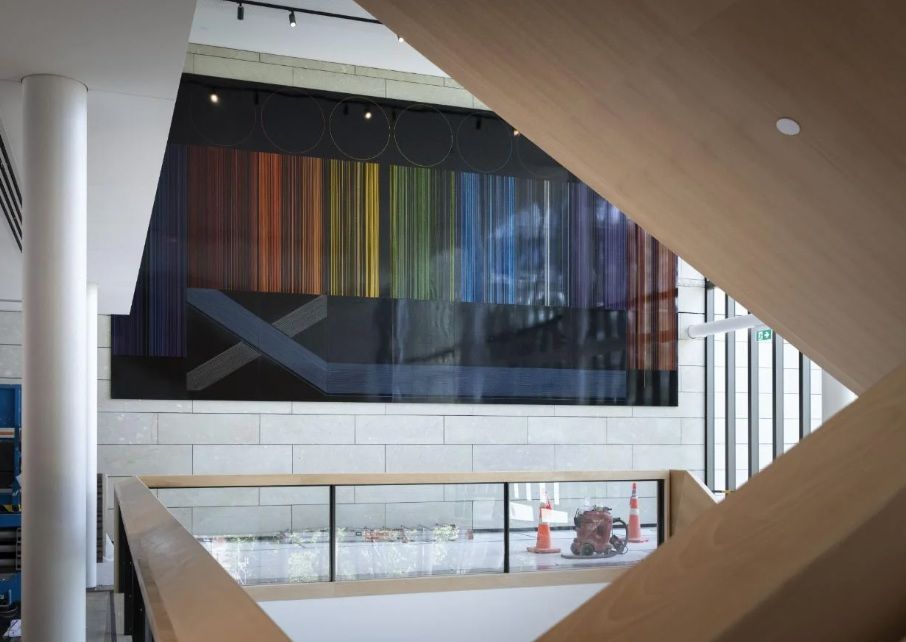
The painting was made with car paint. PHOTO: Kelly Hodel / WAIKATO TIMES.
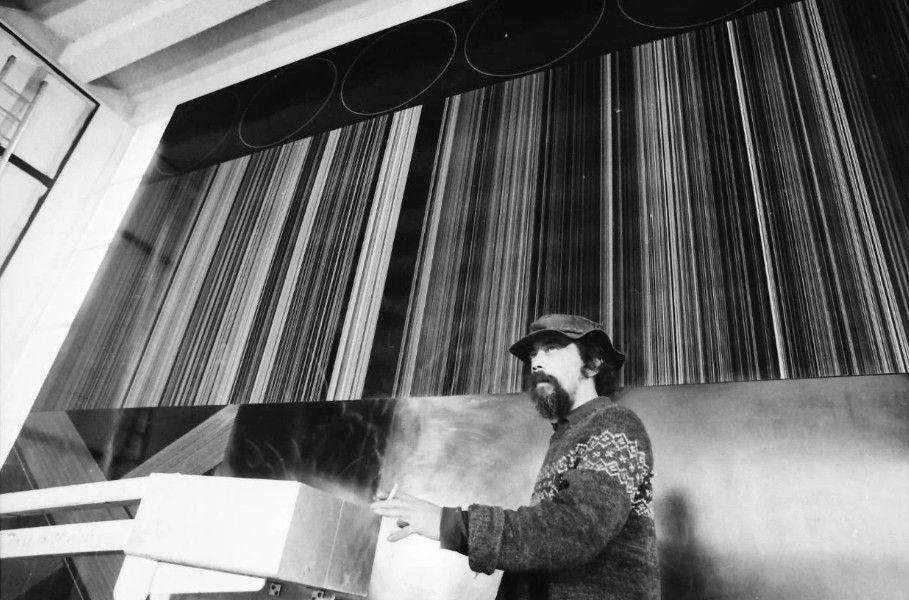
Artist Ralph Hotere in 1973 with the work he had he completed for Founders Theatre.
The artwork itself comprises three panels, with horizontal blue lines referencing the flow of the Waikato River and vertical lines symbolising the many artistic forms found in a theatre—opera, dance, kapa haka, orchestras, plays, and bands. Circular elements at the top of the work represent the seven heavens, or the Matariki star cluster.
Caiger noted how fitting it was that the artwork, which includes a representation of the Waikato River, now looks out directly onto the river itself.
“It is almost like the river in the artwork is flowing out and becoming part of the river outside,” she said.
A journey through time and restoration
Though now considered one of Hamilton’s most significant artworks, the piece wasn’t always treated as such. In its early years at Founders, theatre staff routinely hung posters over it, and furniture and storage boxes were placed against it, causing damage and paint loss. In the 1990s, theatre management even suggested removing the mural entirely to make space for other needs.
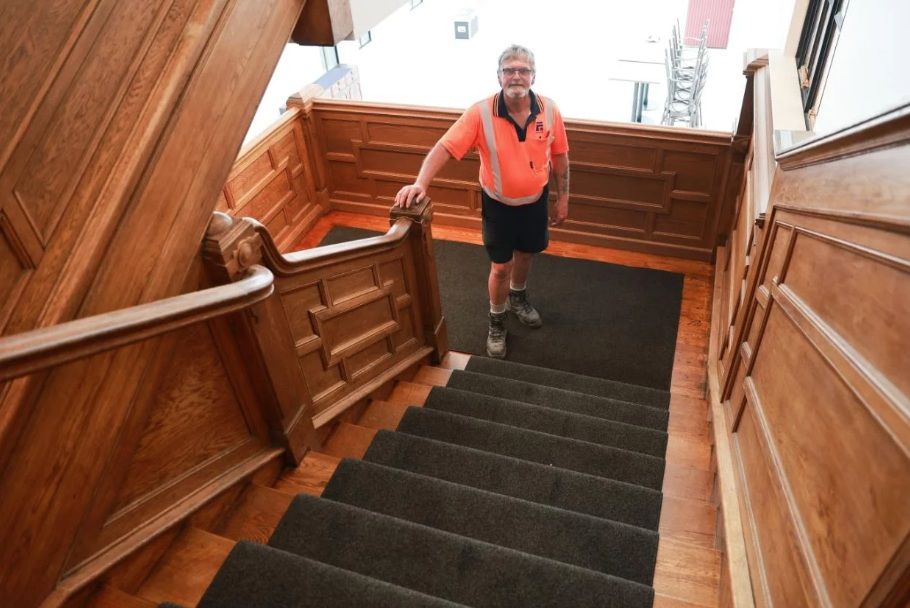
Senior carpenter Johno Weston says restoring the American oak staircase at the Waikato Regional Theatre has been the icing on the cake of his career. PHOTO: Mark Taylor / WAIKATO TIMES.
Reportedly dismayed, Hotere asked for the work to be returned. But in 2000, incoming Waikato Museum director Ray Thorburn successfully argued to retain the piece at Founders. Thorburn, who died in 2023, had himself been a finalist in the same art competition Hotere won in 1973, and had represented New Zealand alongside Hotere at the Biennial Art Awards in Brazil in 1971.
In 2001 it underwent a $50,000 restoration funded by the Hamilton City Council. Hotere personally chose car spray-painter Keith Griffiths for the job, as the work had originally been created using nitrocellulose lacquer—automotive paint.
Even then, the work's full value was not yet fully realised. A decade ago it was insured for $1.5 million. Its current value is now just over $3 million.
Too large and heavy to be casually removed—measuring 10 metres wide by three metres high—the artwork is also well secured in its new location. Caiger hopes the new space will eventually display more artworks of similar stature.
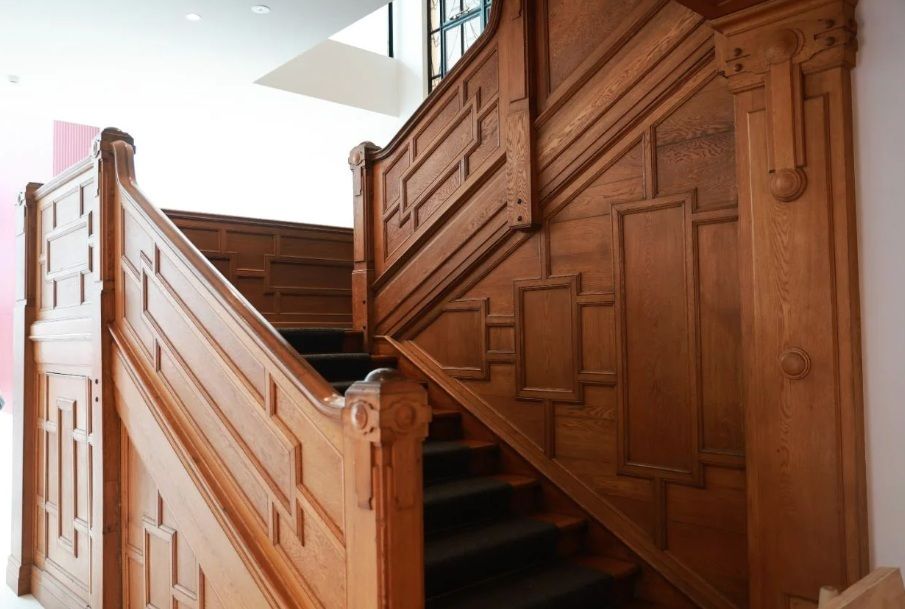
Solid American oak stands the test of time. PHOTO: Mark Taylor / WAIKATO TIMES.
The Queen’s staircase restored
Not far from the piece is another remarkable piece of history—one that connects not just to the city, but to royalty.
A 102-year-old staircase, made of American oak and formerly part of the Hamilton Hotel, now stands again in almost exactly the same location it once did. Salvaged before demolition of the old building, the staircase was carefully dismantled and stored under the guidance of Heritage New Zealand.
Senior carpenter Johno Weston, from Fosters Construction, was responsible for the staircase’s removal and reassembly. The work included cataloguing each part, packing them in specially-made boxes, and storing them in Te Rapa. Weston later oversaw the painstaking process of reinstalling the staircase in the new theatre building.
“This is the icing on the cake of my career,” said Weston. “Not everyone gets to muck around with a 100-year-old staircase. There would be few builders in the country who have been part of a project like this.”
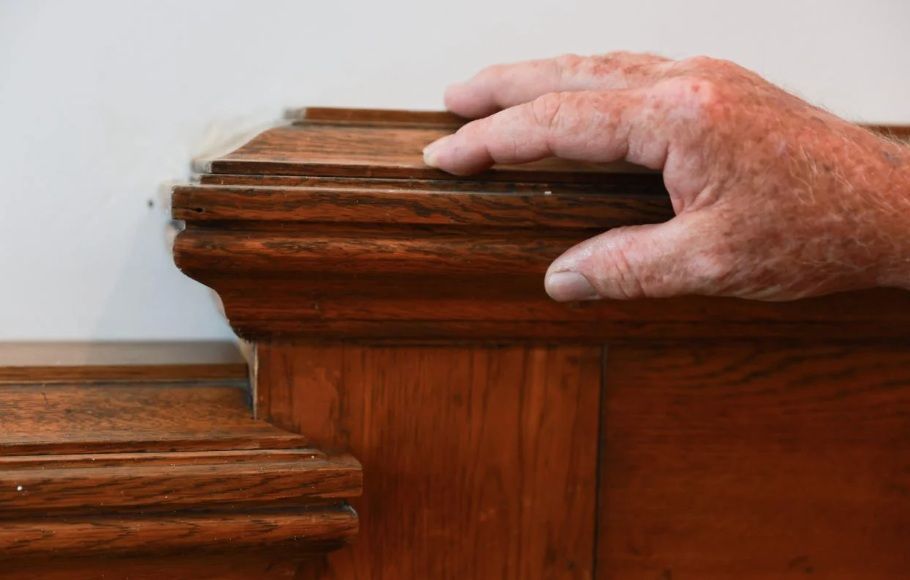
After restoration the staircase is better than new. PHOTO: Mark Taylor / WAIKATO TIMES.
The original Hamilton Hotel was destroyed by fire in 1922, and the second hotel was constructed soon after. The staircase dates from that reconstruction and remained a fixture through multiple uses of the building—including its final phase as a student pub.
In December 1953, the hotel served as accommodation for Queen Elizabeth II and Prince Philip during their royal visit to Hamilton. The staircase was part of that royal experience and, in its new form, continues to be a significant feature of the building.
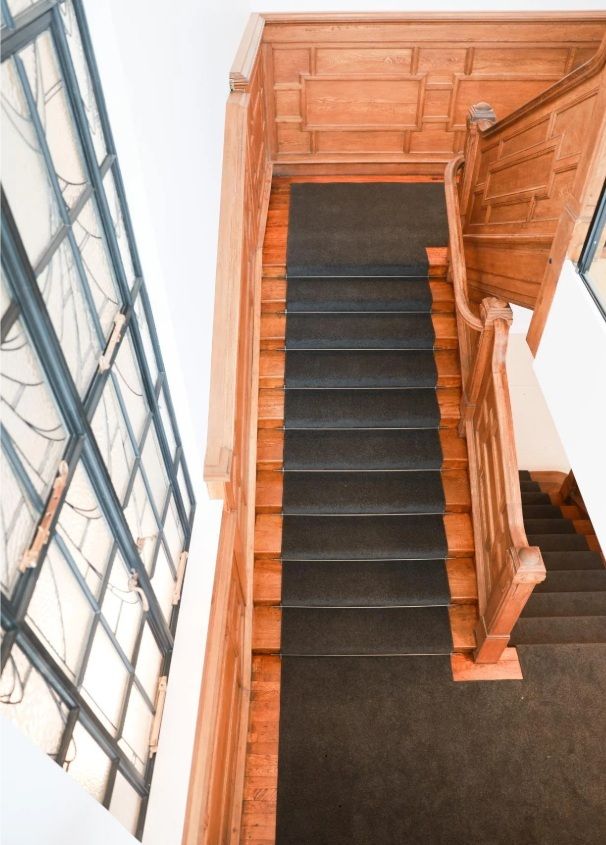
A timeless combination of glass and wood. PHOTO: Mark Taylor / WAIKATO TIMES.
The structure is more than just a historical showpiece. According to Fosters site manager Dave Middlemiss, the entire level structure of the new theatre building was designed around the height of the stairwell.
“Structurally, it is more sound than it probably ever was at any time in the past,” Weston said. “The best thing that ever happened to this beautiful old staircase was us coming along. Who knows what could have happened to it otherwise.”
While the staircase does not link directly to the theatre’s performance spaces, it serves as an accessway to the upper gallery level of the commercial area and hospitality zone.
It has also found a new role as a photographic backdrop. Since the recent opening of the theatre’s downstairs bars and eateries, the staircase has featured in numerous end-of-year party photos.
Both the Hotere and the staircase reflect different aspects of Hamilton’s history—its dedication to the arts, and its layered civic heritage. Their preservation and placement in the BNZ Theatre reconnect the new space to the old, linking Founders Theatre and Hamilton Hotel to the modern arts precinct now rising in their place.